Integrated System Configuration
Without compressing hydrogen,
we store it in a solid-state material.
High-pressure compression consumes 10~13kWh per 1kg of hydrogen. About one-third of the production energy is lost during storage.
Instead of compression, AERO-ONE uses adsorption.
Ni@BNS-GQD Nanomaterial
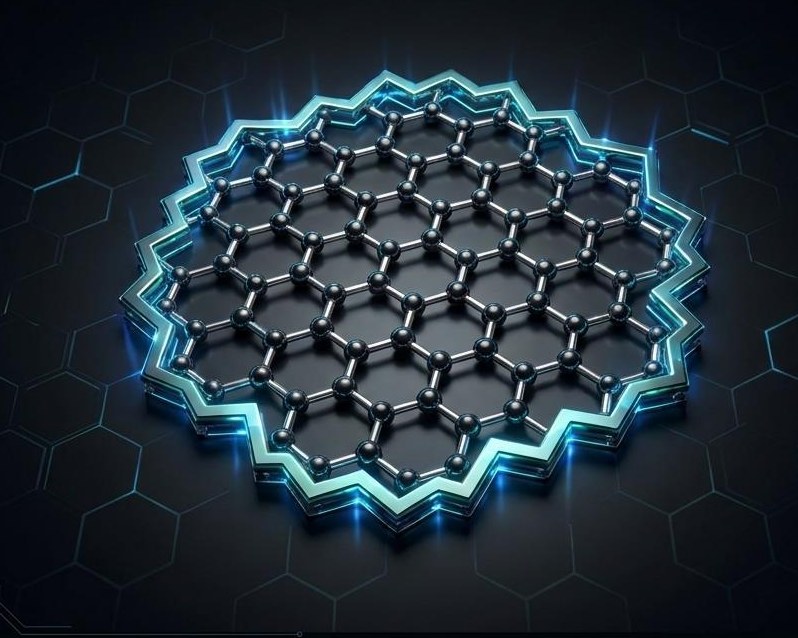
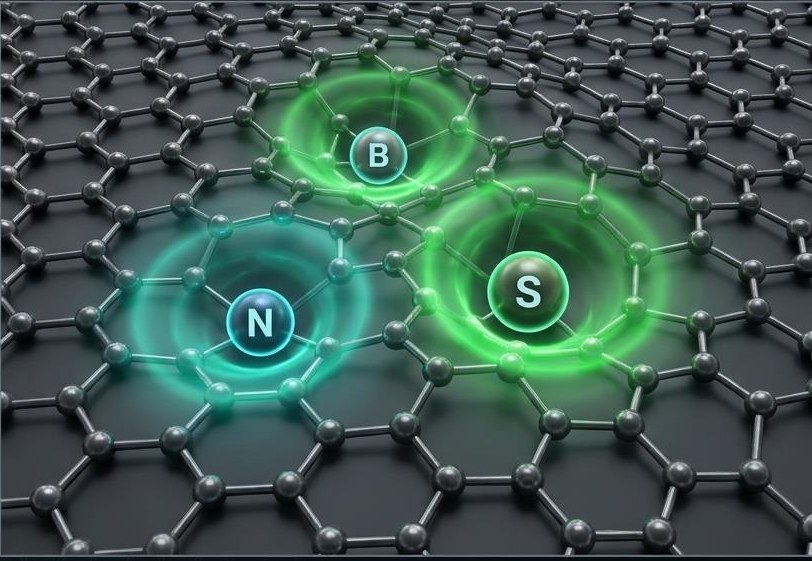
This solid-state storage material comprises boron-, nitrogen-, and sulfur-doped graphene quantum dots loaded with nickel nanoparticles.
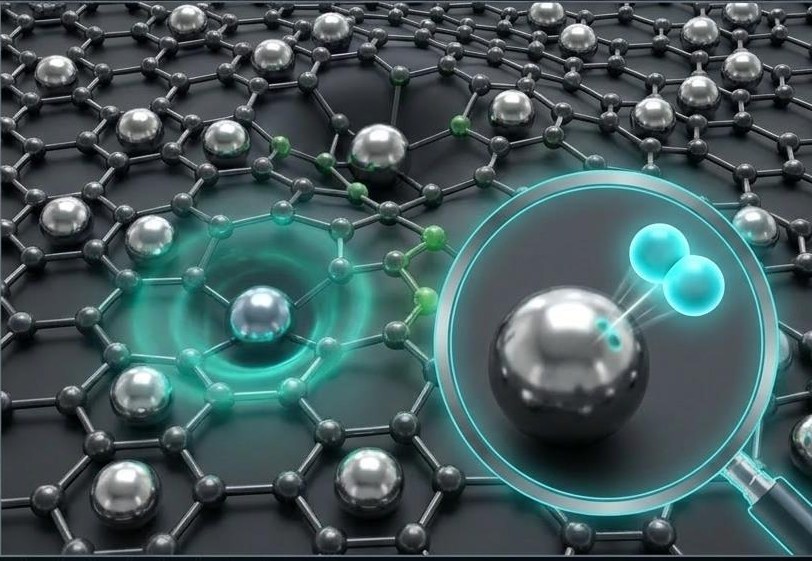
It adsorbs hydrogen at the atomic level rather than trapping intact molecules.
Room-Temperature · Low-Pressure Operation
Hydrogen is stored at 5~20bar rather than in a 700bar high-pressure vessel.
Charging and discharging take place at 20~30°C without cryogenic cooling.
Modular Scalability
The system uses a 1kWh smart module as its basic unit.
Capacity is increased by combining modules to suit the application.
Performance Specifications
Operating specifications for the Ni@BNS-GQD storage module.
Target: at least 5.0 wt%
Compared with 700bar high-pressure systems
No cryogenic cooling required
Minimal performance degradation
From Compression to Adsorption
High-pressure compression imposes constraints on energy, safety, and siting.
Solid-state storage addresses these constraints by lowering the pressure itself.
- Gas compressed to 350~700bar for storage
- Compression power consumption of 10~13kWh per 1kg of hydrogen
- Persistent explosion risk associated with ultra-high-pressure vessels
- Separation-distance regulations and high insurance premiums hinder urban installation
- Large auxiliary equipment such as compression stations required
- Hydrogen adsorbed onto a nanomaterial at the atomic level
- Low pressure of 5~20bar cuts most of the power required for compression
- Low-pressure operation inherently reduces risk
- Suitable for distributed and small-scale installations
- Direct storage from the electrolyzer without a compression station
Storage Principles
Three principles operate simultaneously within a single material.
Triple Doping
Pure carbon is nonpolar and binds hydrogen only weakly.
Doping with boron, nitrogen, and sulfur breaks the electrical symmetry of the carbon lattice, creating polarized sites that attract hydrogen more strongly.
Nickel-Catalyzed Dissociation
Hydrogen occupies substantial volume in its H₂ molecular state.
Nickel nanoparticles uniformly supported on the surface break the molecular bond to form two hydrogen atoms. The reaction occurs at room temperature without high-temperature heating.
Spillover Storage
The dissociated atomic hydrogen migrates from the catalyst across the material surface.
Hydrogen atoms pack densely at the dopant-induced sites, increasing storage density.
Material Structure
Catalytic Adsorption Cycle
Four stages lead from injection to loading.
Hydrogen Injection
Hydrogen enters the porous matrix at a moderate pressure of 5~20bar.
Catalytic Dissociation
Nickel nanoparticles continuously dissociate H₂ into atomic hydrogen.
Rapid Diffusion
The spillover effect creates rapid transport pathways for atomic hydrogen.
High-Density Loading
Doped pores hold atomic hydrogen in densely packed layers.
Material Manufacturing Process
The Ni@BNS-GQD composite is synthesized in three stages.
Precursor Mixing · Doping
Citric acid and melamine are combined to form a carbon base containing nitrogen and sulfur precursors.
Pyrolysis under Nitrogen
High-temperature pyrolysis under an N₂ atmosphere produces graphene quantum dots triple-doped with boron, nitrogen, and sulfur.
Wet Reduction · Deposition
A nickel precursor and reducing agent are introduced to deposit nickel nanoparticles uniformly on the quantum-dot surfaces.
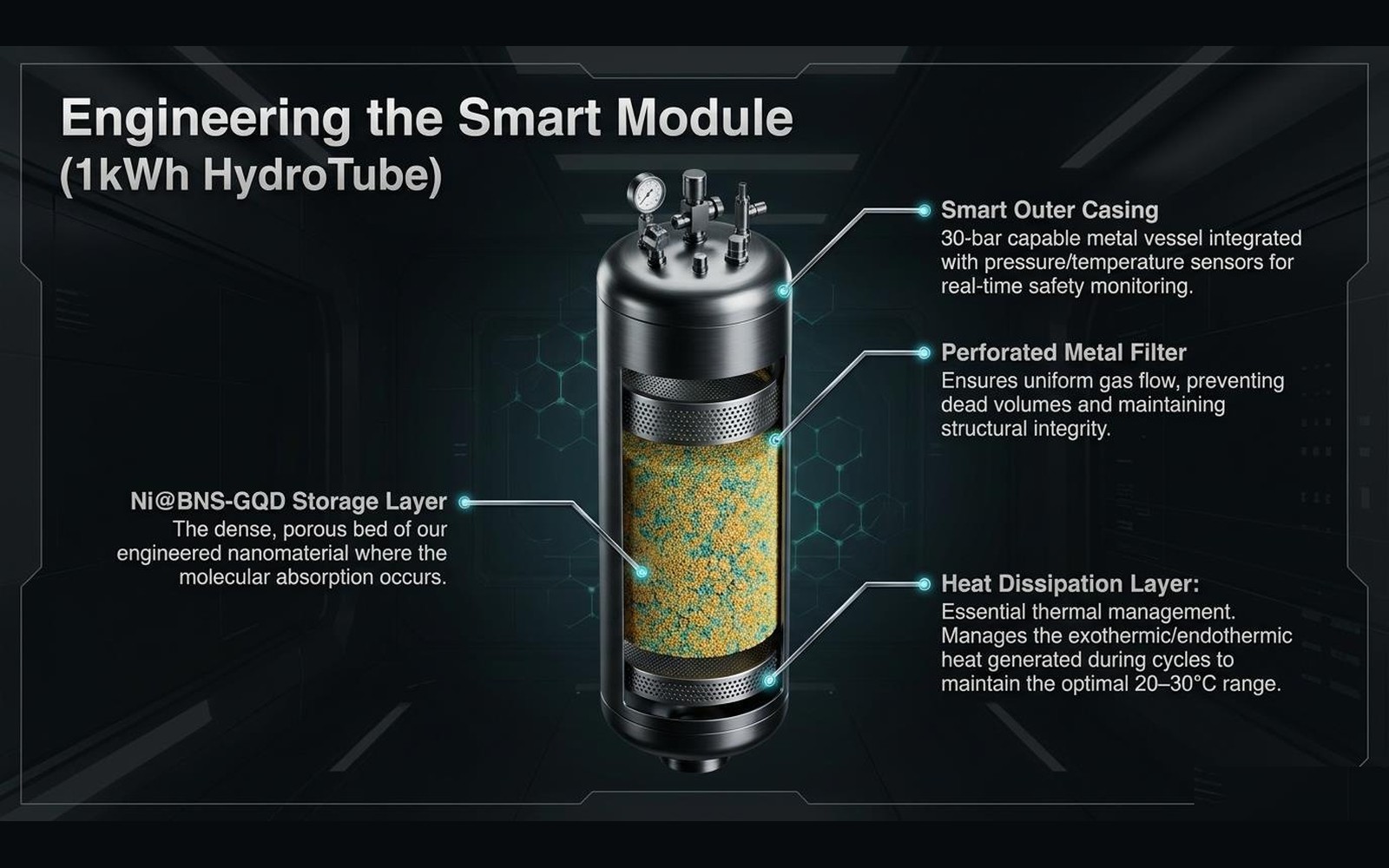
1kWh Smart Module
Four layers turn the storage material into an operational device.
Smart Enclosure
A metal vessel rated to withstand up to 30bar.
Pressure and temperature sensors monitor its condition in real time.
Perforated Metal Filter
It distributes the gas flow evenly.
It eliminates dead space while maintaining structural rigidity.
Storage Layer
This section is packed with Ni@BNS-GQD as a dense porous layer.
This is where adsorption takes place.
Thermal Management Layer
It manages heat release and absorption during charging and discharging.
It maintains the optimal range of 20~30°C.
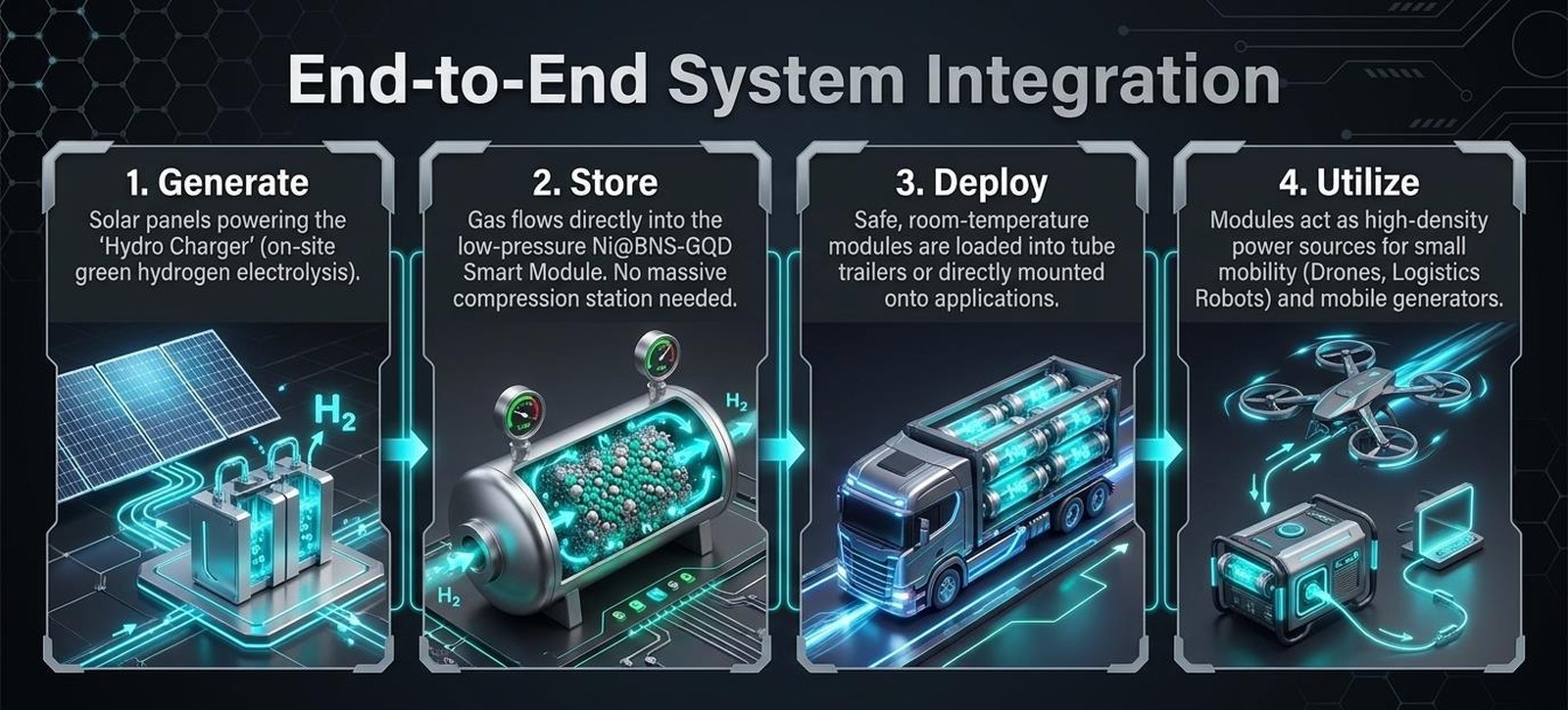
From Production to Use
The system bypasses the compression-station bottleneck.
Production
Green hydrogen is produced on site through electrolysis powered by solar energy.
Storage
The produced hydrogen enters the module at low pressure. No large compression equipment is required.
Delivery
The room-temperature, low-pressure modules can be loaded onto trailers or mounted directly on equipment.
Use
The modules serve as high-density power sources for compact mobility platforms such as drones and logistics robots, as well as mobile generators.
Related Patent
- Patent No.
- No. 10-2545179
- Title of Invention
- Solar- and hydrogen-based mobile power generation apparatus and power generation method using the same
- Filed / Registered
- Filed Dec 2, 2020 · Registered Jun 14, 2023
System configuration